After a while Evelyn said, “Not every found thing is ready to tell its story at once.”
Bran turned that over.
“No,” he admitted. “But one might still keep company with it.”
Bran the Crow and the Silver Key
Bran was not an ordinary crow, though he would have laughed at anyone who said so aloud.
He liked things with hinges, catches, seams, and secrets. He liked the shine of a spoon left in the grass, the clever fit of acorn caps, the little iron gate near the orchard that always stuck in damp weather. Above all, Bran liked locks. Locks suggested that something had been kept safe on purpose. That seemed to him a hopeful sort of habit.
On a cold morning near the edge of Glory Ridge, he saw a glint in the frost-tipped grass. Not the flat glimmer of ice. Not the blink of dew. Something sharper than that.
He hopped closer, head tilting first one way, then the other.
A silver key lay half-buried in the earth, pale as moonlight and nearly as cold. Its shape was odd. The bow curled like a fern frond, and three tiny dots had been worked into the shaft. It was not the sort of key Bran knew, which made it instantly more interesting.
He nudged it free with his beak.
The metal gave a faint little hum, almost like a kettle beginning to think about boiling.
Bran stilled.
“Well,” he said softly. “You’ve been waiting.”
He carried the key to the fence post first, then to the old stump near the meadow path, then to a low branch above the lane, turning it this way and that in the morning light. It smelled of cold metal, damp moss, and the faintest trace of smoke, as if it had once belonged near lamplight and warm hands.
That afternoon he tried it, carefully, at the small gate beside the orchard. The key did not fit.
The next morning he tested it against the latch of an empty feed box behind the barn. Still nothing.
After that he tried the little wooden chest in the workshop porch, the bent lock on a garden shed, and the brass catch on an old biscuit tin someone had left near the Long Table House for buttons. Nothing. The key only kept up its quiet hum, patient as ever.
By the third day, Bran had stopped feeling clever about it.
By the fourth, he had begun to feel responsible.
He did not say this to anyone. Crows have their pride. But once a thing has been found, it ought not remain unfound forever. That seemed plain enough.
So Bran began carrying the key with him on his rounds.
He took it to the meadow at dawn, where the frost lifted in threads and the sheep moved like little clouds with hooves. He took it along the lane, where baskets passed from hand to hand and no one ever seemed quite surprised to find the right thing arriving where it was needed. He took it to the pond at dusk, where the willow leaned over the water and the surface held the last of the light.
Each evening he set the key down beside him and listened.
No voices. No instructions. Only that faint hum, as if the key was less interested in being used than in being accompanied.
On the seventh evening, the moon rose white and round over Crystal Pond. Bran perched on a willow branch with the key held carefully in one claw. Below him, the water lay still enough to keep the sky.
He looked at the key and clicked his beak.
“It would be very helpful,” he said, “if you’d make your purpose known. I have been diligent. Exceptionally so.”
The key warmed suddenly against his claw.
Before Bran could grip it more tightly, it slipped free and fell.
He gave a startled croak and flared his wings, but it was too late. The key dropped into the pond with hardly a splash, sending out neat rings that widened through the reflected moon.
Then, below the water, something answered.
Not a door. Not exactly. More like a round outline of pale light deep beneath the surface, as though some old lock had turned where no lock ought to be.
Bran leaned so far forward he nearly tumbled from the branch.
The pond held still again, but not quite as it had before. The place where the key had sunk seemed somehow attentive. Waiting, perhaps. Or simply awake.
Bran’s heart beat hard under his feathers.
He did not dive after it. Bran was curious, not foolish. Besides, some mysteries improved if left one more night to themselves.
So he came back the next evening. And the one after that.
He began to keep a kind of watch.
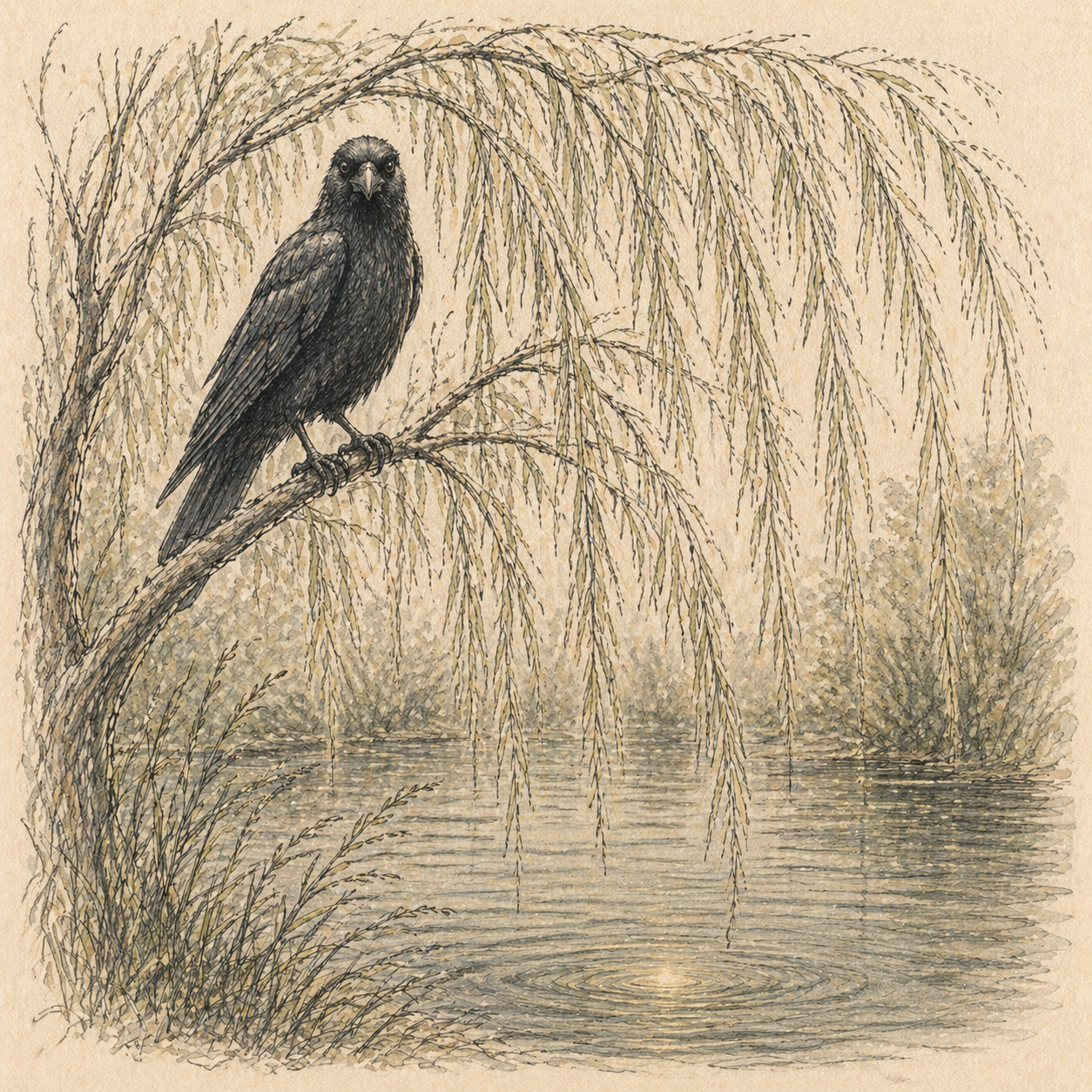
Not all day. He still had his rounds to make, and a respectable crow could not be expected to abandon every other interest simply because a pond had become interesting. But he came often enough that the willow branch above the water became his branch. He learned the hour when the pond darkened first, and the hour when the frogs began, and the way the wind changed when rain was coming up from the lower fields.
Sometimes other creatures passed and asked what he was doing.
“Observing,” Bran would say.
“Waiting,” if he was in a more truthful mood.
Once, when the evening had gone soft and blue around the edges, Evelyn came by with a lantern in one hand and a basket over her arm. She stopped beneath the willow and looked up at him.
“You’re here often lately,” she said.
Bran gave the sort of small shrug a crow can manage.
“There’s something in the pond,” he said.
Evelyn did not laugh. That was one of the useful things about her.
Instead she set down her basket and looked at the dark water. “Something lost?”
“Something found,” Bran said. “Then dropped. Through no fault of mine.”
“Of course.”
He shifted on the branch. “I believe it may open something.”
Evelyn glanced up. “And until it does?”
Bran looked at the pond. The moon had not risen yet. The water only held the dim shape of the willow and the first small star above it.
“Until then,” he said slowly, “it seems to want looking after.”
Evelyn nodded as if that made perfect sense.
She hung the lantern on a low willow hook, where its light reached the water without disturbing it. Then she stood beside the pond with Bran for a quiet minute, saying nothing more. The basket at her feet smelled of bread crust and rosemary. The lantern smelled faintly of oil and warm tin.
After a while she said, “Not every found thing is ready to tell its story at once.”
Bran turned that over.
“No,” he admitted. “But one might still keep company with it.”
“That has its uses too.”
When she had gone, leaving the lantern lit for a little while longer, Bran stayed where he was. The pond no longer felt like a place he was trying to solve. It felt more like a place he had joined.
The key had not opened a chest or a gate or some grand hidden room. Not yet, anyway. But it had given him a reason to return. A reason to watch. A reason to know one branch, one pond, one hour of evening more carefully than he had before.
In the days that followed, creatures began to say, if they needed Bran, that he would likely be near Crystal Pond by dusk.
And they were usually right.
Bran never made a speech about this. He would have found that embarrassing. But when he settled onto the willow branch each evening, feathers sleek against the cooling air, he no longer felt as if he were waiting for a mystery to resolve.
He felt useful.
The pond lay below him, dark and patient. The lantern hook on the willow sometimes held a light. The first stars came one by one. Far off, from the farm, came the softened sounds of animals bedding down for the night.
And from the rise above the water, if one happened to pass that way, there was often the sight of a black crow keeping watch over a place that had not yet finished becoming itself.
“Come back anytime, or read again from here…”